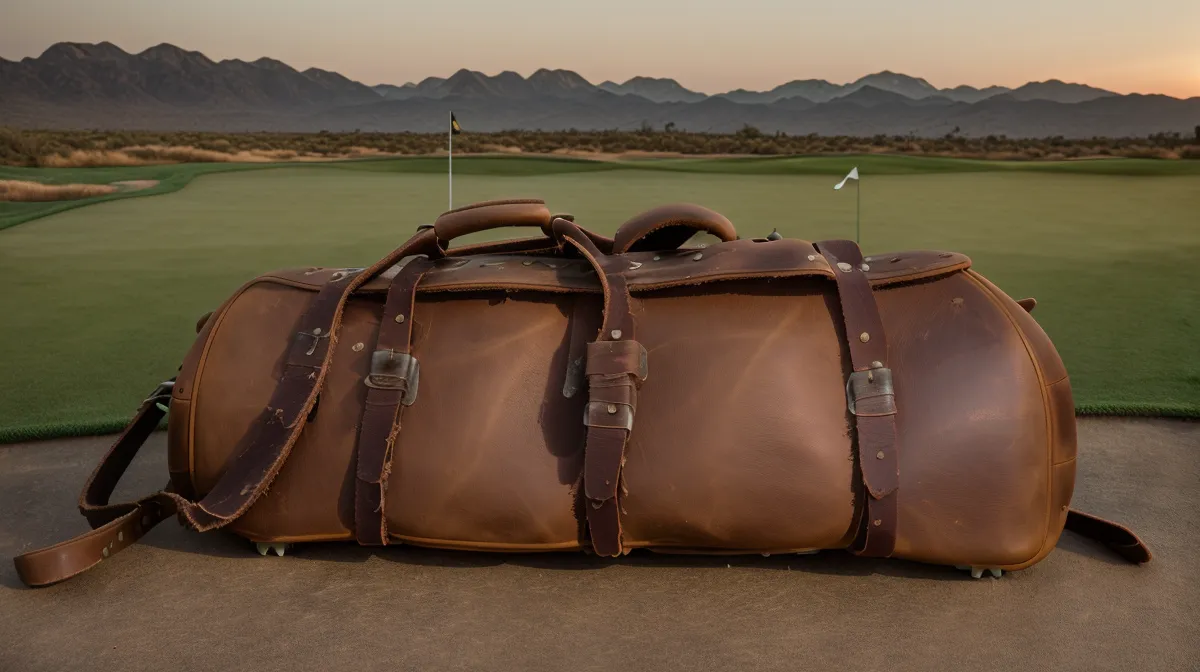
165 yards. Mid-November. 82 degrees. I stood on the 14th hole at a North Valley course where the elevation change makes you question every life choice you made since breakfast. I was leaning my entire body weight into a manual push cart; I felt my 2020 knee injury flare up as the wheels skidded on the dry desert hardpan.
Some links on this page send a commission my way at no extra cost to you. I earn a commission when you buy gear through these links, but the picks here come from equipment I actually rotated through over real rounds in the Phoenix valley; I never use press kits or sponsored loaners. You can find my full testing notes in the Editorial Policy.
Walking 18 holes in Scottsdale, Arizona is a physical negotiation. The Phoenix valley contains over 200 golf courses; many feature desert-style target layouts with long, punishing transitions between holes. My notebook of failed gear is thick. I have rotated through over a dozen bags, push carts, and putter setups over the last four years. I am not a pro; I am just a 47-year-old commercial real estate broker who refuses to ride in a cart despite a left patella that remembers every mile. I tracked my progress in The Scottsdale Walk: My Gear Tracking Notes After a Full Year on the Grass, but the cart itself was the final hurdle.
The Lightweight Trap: Why Mass Matters on Side-Hills
The common wisdom says to buy the lightest push cart possible. Most reviewers suggest carbon-fiber models or ultra-slim aluminum frames that weigh next to nothing. After about twenty rounds on the steep side-hills of the North Valley, I realized that advice is a trap. A lightweight cart lacks gravitational mass; it becomes prone to tipping over when you are traversing a slope. I have spent too many afternoons chasing a runaway bag down a ravine because the cart was too light to hold its line.
Think of it like a daily-driver pickup truck. You do not want a truck that feels like a tin can when you are hauling a load up a mountain. You want something with enough heft to stay planted. When you are walking a course that covers between 5 and 7 miles, you need stability over the terrain, not just a low number on a scale. My notebook is full of entries where 'featherweight' carts failed the turtle test on the 5th hole. If the cart is too light, it skitters; if it is too heavy, your knees pay the price. The solution was not a new manual cart, but a change in how the cart moves.
The 30-Minute Garage Conversion
I stopped buying new frames and decided to electrify the one I already liked. I picked up the Alphard Golf Club Booster V2Pro. It is a motor kit that replaces the rear wheels of almost any standard push cart. I am not a mechanic, but the surprisingly quick 30-minute conversion in my garage was painless. It felt like swapping the soles on a favorite pair of work boots; you keep the part that fits and upgrade the part that does the work.
The kit includes US-assembled hardware and comes with a two-year warranty, which matters when you are grinding through the dust and heat of the valley. I was skeptical about the battery life until I hit early March. I started testing it on double-headers—36 holes in a single day. The 36-hole battery capacity is a legitimate claim; it survived the second round with plenty of juice left in the tank. The current price is on the vendor's page and can change, but for a guy who plays three times a week, the reliability is the primary metric.
The Turning Point: Guiding Versus Pushing
The shift from pushing to guiding changed my entire approach to the game. USGA Rule 4.3 allows the use of equipment to help with the physical act of playing, and this feels like having a caddy who never complains about the heat. One morning, I was testing the remote tracking on a steep side-hill lie where manual carts usually turtle. I realized I was walking with my hands in my pockets instead of white-knuckling a handle. I noticed the low-frequency whir of the motor kicking in just as the cart started up the steep transition to the fifth green. It is a subtle sound, but it represents the end of the struggle.
By the time I reached the back nine, I noticed the specific absence of a dull throb in my left patella while walking back to the parking lot. Usually, by the 14th hole, I am focused on my knee; now, I was actually reading the greens. When you are not fighting the weight of the bag, your heart rate stays lower, and your 14-handicap self might actually hit a decent approach shot for once. I even started carrying a SWAG Golf Putter, knowing the precision-milled 303 stainless steel head was safe from the vibrations of a bumpy manual ride. If you are curious about those flatsticks, check out my SWAG Golf Putter Review.
Surviving the Arizona Summer Double-Header
One humid morning in August, the temperature was already climbing toward triple digits before we cleared the 9th hole. Most gear starts to fail in that kind of heat. Grips get slick, and batteries can overheat. This is where the long-term testing pays off. After 50 rounds, I can say the V2Pro handles the heat better than I do. You do have to watch the front-wheel tracking; it can drift on uneven terrain until you dial in the weight balance of your bag. I keep a few extra Vice Golf balls in the lower pocket to act as a counterweight; it helps the cart track straight when the desert floor gets uneven.
I also switched my footwear to handle the extra mileage. I have been wearing FootJoy shoes because of their two-year waterproof warranty and the lateral support they provide. When you are walking 7 miles, your shoes are as much a part of your equipment as your driver. I documented how they held up during a rare wet season in my FootJoy Pro/SLX Review. Combining a motorized cart with the right shoes is the only way I am still playing at 47 without a cart seat under my rear.
Long-Term Maintenance and Reality Checks
No gear is perfect. I have seen reports of battery degradation after a couple of seasons of heavy use, which is why I wrote a guide on How to Maintain the Alphard Club Booster V2Pro for Long Term Use. You have to keep the axles clean. The desert sand is like sandpaper on moving parts. But compared to the cost of a new cart every season, maintaining a motor is a better investment. It is like an old leather wallet; it gets better as you learn its quirks, provided you take care of the stitching.
If you are tired of the post-round ice packs and the struggle on the 14th hole, stop looking for the lightest cart on the market. Look for a system that takes the work off your joints. The Alphard Golf Club Booster V2Pro turned my favorite manual frame into a tool that actually saved my season. It is not about being lazy; it is about being able to play the game I love without the physical tax. Check the current specs and availability on their site to see if it fits your current setup.
The next time you are standing at the bottom of a North Valley hill, you can either lean into the handle and pray for your meniscus, or you can press a button and watch your clubs climb the hill for you. I know which one my notebook recommends.