Would you trust a pair of cheap hardware-store dowels over a set of alignment sticks that cost as much as a decent round of golf? I didn't, not until a rod with machined aluminum joints and a padded carrying case failed on me before I'd even worked through a full bucket. That's the question this whole alignment-sticks comparison keeps circling back to: does the boutique gear actually improve your golf practice drills, or does a plain solid rod do the same job for less and survive longer? I'm Scottsdale-based, play to roughly a 13 handicap, and after rotating enough rods through my bag to fill a shed, the answer surprised me: equipment durability, not price, decided which sticks stayed in the bag.
Two rods, two philosophies, and that's really what this comes down to. On one side sit the solid fiberglass or wood rods that just about every muni pro shop sells for a few dollars; on the other are the collapsible aluminum kits marketed at golfers who fly to buddy trips and don't want a forty-eight-inch rod sticking out of a carry-on. I've carried both kinds long enough to trust a verdict, and only one has earned a permanent spot in my bag.
Why a Clubhead Isn't an Alignment Tool
A golf club is round and bulky; it doesn't give you a straight visual reference the way a rod does. Lay a 7-iron on the turf and you're guessing at the line more than reading it. That's the whole case for carrying a dedicated rod in the first place, and it's why I stopped throwing a spare iron down at Wigwam Golf Club in Litchfield Park and started laying down something built for the job. A club is a hitting tool before it's ever an aiming tool, and treating it like both is how a lot of mid-handicappers end up aimed well off target without ever knowing it.
Solid Rods and the Bag Test
Fifty rounds is my baseline before I trust any gear opinion, mine included. Work boots feel great in the store; you don't know the truth until the leather's taken some rain and a lot of miles. Solid rods, boutique leather-wrapped ones, and collapsible kits all went through that same rotation before I'd trust a verdict on any of them.
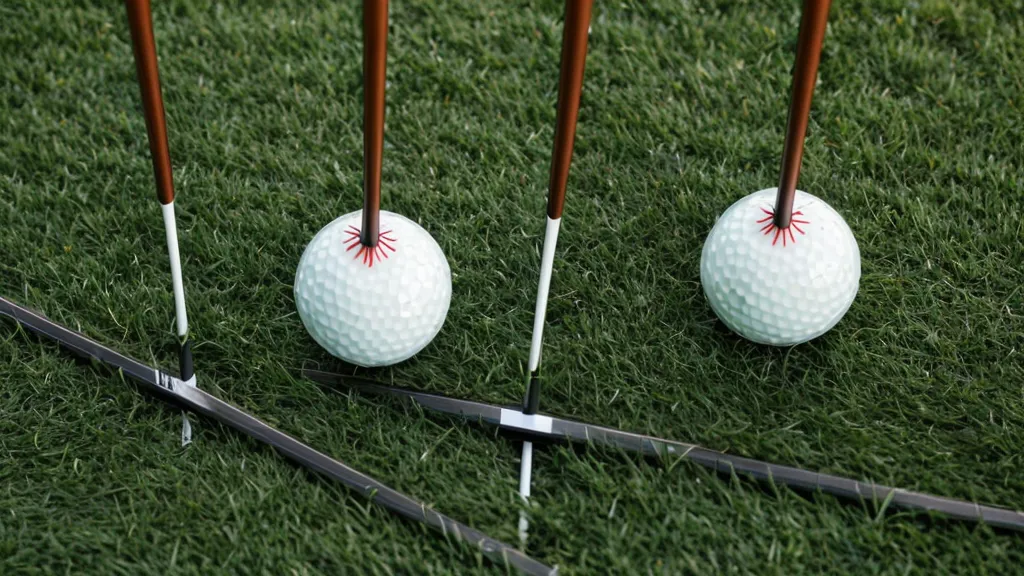
Length matters more than most shoppers think. Forty-eight inches is the number that keeps showing up on solid rods, and it isn't arbitrary; anything shorter rattles loose against your wood covers, anything longer turns into a hazard the second you're walking off a green with the bag on your shoulder. Solid fiberglass and solid wood rods hold that length without complaint, especially in neon yellow or orange, colors that actually show up against grass instead of disappearing at your feet.
Cheap, uncapped fiberglass is where the real problem shows up. Raw rod ends fray and bloom over enough rounds, and without a rubber cap on both ends you eventually reach into the bag and pull out a handful of splinters instead of a handle. I learned that on a hot practice day reaching for an uncapped rod; my palm remembers it more than my scorecard does.
Where Collapsible Sticks Quit
The collapsible kits fail at the joint, not the rod. An internal bungee cord holds the segments together, and that cord is the entire weak point of the design. Picture an old leather wallet stretched out of shape; once the tension is gone, it's done. Mine sagged in the middle after enough time riding in a hot trunk, throwing my visual line off by a few degrees right when I needed it dead straight. Skip Dabrowski, who I play with most Saturdays, watched me try to snap one back into shape on the range once and just shook his head.
Money doesn't fix that kind of failure either. I've spent more on a single custom-fitted driver than on every alignment rod I've ever owned combined, and I was still too stubborn for years to spend a little extra on the tool that keeps my feet aimed at the target instead of the desert scrub past it. If you're working on ball-striking instead of setup, you might be comparing Titleist T150 vs T200 Irons for amateur golfers right now, but even a perfectly fit iron won't save a swing built on a bad line.
Alignment Sticks: Solid vs Collapsible, the Case for Betting on Boring
Set the two side by side and the case isn't close. A solid rod costs little, shrugs off heat, and does exactly one job. A collapsible rod costs more, buys you a few inches of trunk space, and starts failing right around the round count where a solid rod is just getting broken in. Choose collapsible only if you're flying to a golf trip and the case genuinely won't zip shut otherwise; for anyone practicing at home courses week after week, solid wins on every measure that matters past fifty rounds.
Stop Leaning on the Sticks Every Session
There's a real dependency risk here, and it's the part most gear reviews skip entirely. Lean on the rods every single range session and your eyes forget how to find a target without them. Step onto the first tee at Wigwam with no orange lines on the ground and the target suddenly feels harder to find than it should. Kenny Prater, a guy I've crossed paths with in weekend groups a handful of times, is convinced ball speed off the driver decides everything and has never once carried a rod in his bag; watching him aim by feel alone is its own argument for at least occasionally checking your line with one.
The fix isn't complicated. I use the rods for the first stretch of balls to calibrate, then move them aside and finish the session aiming from memory. Sliding indicators and printed measurements on some sticks miss the point entirely; a rod is a reference line, not a ruler, and golfers who treat it like a measuring device usually spend more time reading the stick than reading the shot. That's also true of a different piece of gear I gave up on entirely: a pair of spikeless shoes from a big-box store that looked fine in the shop and lost every bit of grip the moment I hit the hardpan waste areas on a real round. Cheap gear doesn't always announce itself as cheap until the moment you actually need it.
If misreads keep creeping into your round despite good aim, the irons themselves might be part of it. I've gone down that path too, looking at how to choose Cobra driving irons for more fairway consistency, and even that search comes back to the same lesson: a good line means nothing if the club can't deliver on it, and a good club means nothing if you never checked the line.
Check the Rulebook Before Competition Day
There are a couple of rules worth knowing before you bring rods to a real round instead of the range. A golf ball has to meet USGA size rules, which is part of why lining up two of them side by side makes a reliable width gauge for a putting-gate drill without needing a tape measure. The bigger one to know is the rule that actually trips golfers up: USGA Rule 4.3a limits when alignment devices can be used once a round is live. I've watched a guy get called out at a club event for leaving his rods down on the practice green a little too close to his tee time. Pack them away before you sign a scorecard.
The Rest of the Gear Notebook
You don't find out gear works while you're standing in a pro shop; you find out later. I know a glove is doing its job when I peel it off after the back nine in the worst of Scottsdale's August heat and my palm is still dry. Alignment sticks are the same kind of proof: cheap or expensive, you only really know after enough rounds in real conditions.
Alignment sticks are one line in a much longer notebook. Some entries are about the cart that gets a bag to the tee: how a push cart holds a straight line on a downhill run without drifting, how small it actually folds down once it's time to load the trunk, and how many extra pounds a stand bag adds by the back nine. Others are about what's in my hands: whether a fatter putter grip actually takes pressure off my wrists, whether a mallet forgives a bad stroke better than a blade, and how much easier a cavity-back iron is to launch than the blades I used to carry. A few are about the ball itself: whether the cover survives being scraped across a cart path round after round, whether the compression actually matches a moderate swing speed, and whether the color holds up against desert glare on a bright afternoon. And some are about the body: how a spiked shoe grips hardpan compared to a spikeless one, how a wedge's bounce reacts to a hardpan fairway, and how long a glove lasts before the heat wins.
None of this makes an alignment stick a status symbol. A ball doesn't know whether the rod on the ground cost a few dollars at a hardware store or came in a branded case; it only knows whether the clubface was square at impact. My notebook backs that up more than any marketing copy has: the rounds that scored best followed sessions where I used the simplest rod to check my basics, then had the discipline to put it away and trust my eyes on the course.