
I've watched a stand bag do a slow, deliberate spin inside a push cart cradle, mid-round, for no reason I could see. I have, more times than I'd like to admit, after rotating through more bags, carts, and putters than any one golfer needs. Golf bags built for walking golf are supposed to lock into a push cart and stay there; too many don't. I'm playing off a 13 handicap this year, and this is a straight breakdown of what actually keeps a stand bag from twisting on Arizona golf terrain, built from gear rotated through real rounds, not a marketing sheet.
A few links below send commerce my way if you buy through them; I earn a small commission at no cost to you, and none of this gear arrived as a sponsored loaner. Every product mentioned here got pushed, pulled, and rattled around a cart for enough rounds to know its actual failure points, not just its spec sheet.
The Push Cart Cradle Problem Nobody Talks About
Most stand bags fail for one mechanical reason: the actuator, the plastic foot that pops the legs out when the bag comes off your shoulder. That mechanism creates a gap between the base of the bag and the cart bracket that's supposed to hold it steady. On a smooth cart path you'd never notice; on a rutted desert path, that gap is exactly where the twisting starts. A push cart with a tight, well-built cradle limits how much a bag can shift, but no cradle fixes a bag that was never built to sit flat in the first place.
The cart itself matters too; I've broken down what separates a push cart that tracks straight on a downhill from one that wobbles in the best non electric golf push carts piece, but no cart cradle fixes a bag base that was never flat to start with.
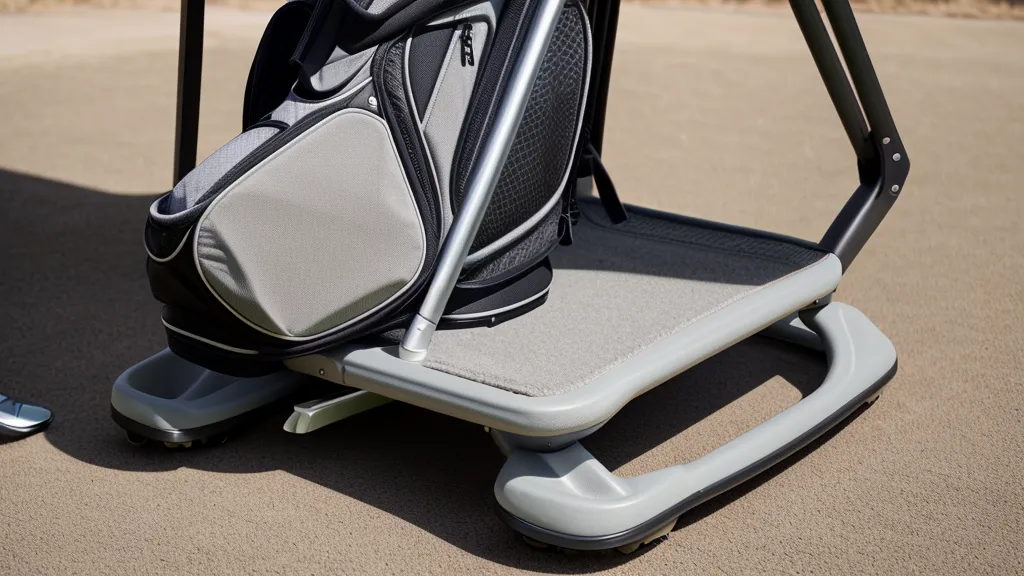
The Motorized Torque Factor
A motorized push cart changes the stakes considerably. The Alphard Golf Club Booster V2Pro converts a manual push cart into a remote-controlled electric caddy in well under half an hour, and it holds a charge across roughly 36 holes before it needs a plug, which matters on a valley course where the walk between green and tee can run long. Lonnie Gruber, a guy I've known for years from the contracting world who picked up golf seriously a couple years back, texted me three separate times asking whether he needed one before he ever bought his own; he didn't order it until his manual cart's front wheel locked up mid-round and he had to carry his bag the last four holes.
Torque is the part people miss. A remote-controlled cart puts far more twisting force through the bag than a manual push ever will, and if the bag isn't seated flush in the cradle, that force will walk it right out over a few holes. I've watched guys chase a bag down a slope because they never accounted for the shift in center of gravity once the cart takes over the steering. Stable footwear matters here too, if only because you're the one jogging after a runaway bag; I wear FootJoy Pro/SLX on most rounds, and if you deal with high arches the way I do, the best golf shoes for walkers with high arches breakdown covers what actually holds up.
Why Does Adding Weight Actually Stabilize a Stand Bag?
Conventional wisdom says the lighter the bag, the better for walking golf. That's true for your shoulders and false for your cart. A stand bag riding light and empty in a cradle has almost nothing holding it down against a bump, and it rides high and loose exactly where it needs to sit flat. Add weight low in the bag, down near the base where the club heads sit, and the center of gravity drops enough that the bag stops bouncing loose on rough ground. Weight stacked up high, in a strapped-on rangefinder case or a jacket wadded into the top pocket, does the opposite; it raises the pivot point and makes the twisting worse, not better.
A milled putter helps more than people expect. The head on a SWAG Golf Putter is precision-milled 303 stainless, assembled in the US, and that extra heft sitting in the putter well does real work lowering the bag's balance point. It's a premium piece with resale value that holds up because the drops are limited, but the weight is the part that matters here, not the collectibility.
Balls do the same job lower in the bag. I quit carrying a lone sleeve and started packing a full dozen Titleist Pro V1s in the lower side pocket, and that dozen sits like ballast, keeping the bag from bouncing when the cart hits a rut on a cart path at Wigwam Golf Club in Litchfield Park. Titleist balls carry a premium price tag that adds up across a season of lost sleeves, so if the cost stings more than the ballast helps, Vice Golf balls sell direct with no retail markup and a subscription discount if you go through more than a couple dozen a year; they carry the same weight in the pocket and hold up fine for a mid-handicap swing.
Match the Strap Channel to Your Grip Setup
Bags with a dedicated cart-strap channel hold rock-solid in a cradle, but that stability has a cost. Running the strap through the channel pulls the fabric tight against the internal club dividers, and mid-irons especially start snagging on the pull every single time; twenty-some rounds of yanking on a stuck 7-iron will teach you to notice it fast. A bag without that channel moves more in the cradle but lets clubs slide free without a fight. There's no version of this that avoids the trade-off entirely.
Grip thickness changes how much that snag actually bothers you, which is something a reader named Gord Szabo, a construction supervisor out of Chandler, wrote in about after finding the site while researching grip size and wrist discomfort; he plays enough rounds in a year that his gear wears out faster than most recreational golfers ever see, so a tight club pull isn't an abstract annoyance for him, it's a weekly one. Thicker grips pull looser from a snug channel because there's more surface for your hand to find without wrestling the club free, which is the whole idea behind the best oversized putter grips piece I put together after that thread with him.
A Blade Putter Taught Me the Hard Way
Not every swap works out, and the clearest example in my bag was a putter, not a bag. I switched to a blade putter a while back because that's what tour pros carry, figured the shape had to translate. Six straight rounds of three-putting later, I put it back in the closet. A blade demands a level of face control I don't have on a bad-tempo day, and a mallet or a more forgiving head design covers for that a lot better on a mid-handicap stroke; there's a longer breakdown of mallet-versus-blade forgiveness worth reading before you make that same swap on a hunch instead of a fitting.
Which Bag Base Actually Survives a Cart Cradle?
The base geometry decides more than the fabric or the pocket count. Cobra Puma stand bags do well here because the stand mechanism sits recessed into the base instead of sticking out as a separate foot, so the bag drops into a cart's lower cradle clean, with nothing external catching on the bracket. That flat-base design doesn't fight the cart strap and it doesn't rotate when a motorized unit takes a hard turn. Compare that to a bag with a bolt-on external foot, which almost always leaves a gap wide enough for the bag to rock.
Everything else in your setup either compounds a stable base or undoes it. Balls scuff fast off cart paths and hardpan lies out here, and picking a cover that actually holds up to desert scrape is worth its own separate look rather than a footnote. Compression matters too, more than most mid-handicappers check for, since a ball built for tour swing speeds won't compress right off a moderate-speed strike, and that mismatch shows up in short-game control before it shows up anywhere else. Shoes matter on hardpan the same way tires matter on gravel; traction on baked-out desert dirt is a different problem than traction on wet turf, and it deserves its own look at spike patterns rather than whatever came standard on the shoe. Irons play into the same forgiveness logic in a smaller way; anyone easing off a blade the way I eased off that blade putter should expect the same gap moving into forgiving-iron territory.
Gloves take the most abuse of anything in the bag, and dry hands the whole way around eighteen holes is the real test, not how the leather feels fresh out of the wrapper. I peeled my glove off after a full loop at Wigwam Golf Club one August afternoon and the palm was still bone dry, which told me more about that glove's construction than any spec sheet would. Between rounds I hit the seams with a shot of compressed air, a quick cold hiss cutting through the sweat-damp stitching before it's gone, just to keep the leather from breaking down early. How long a glove actually holds up in that kind of heat is its own question, worth answering separately from bag setup.
Buy the Base, Not Just the Brand
After enough rounds pushing carts around valley courses, the base geometry is still the deciding factor, not the fabric weight or the pocket count. I've run the Alphard Golf Club Booster V2Pro for well past fifty rounds now, and even with the battery-degradation reports that show up after a season or two of heavy use, mine still finishes a full 36-hole stretch without dropping charge mid-round. The lesson holds regardless of which cart you run: buy the bag because the base fits the cradle, not because it's the lightest thing on the rack. Your knees are the ones that pay for a bag that fights the cart every round.
If your bag still rotates in the cradle by the back nine, the fix is rarely the cart. Check the base first, then look at what's riding inside it. Grab the Alphard unit if you're tired of pushing dead weight uphill, pair it with a bag that actually seats flat, and stop wrestling gear that should just be doing its job.