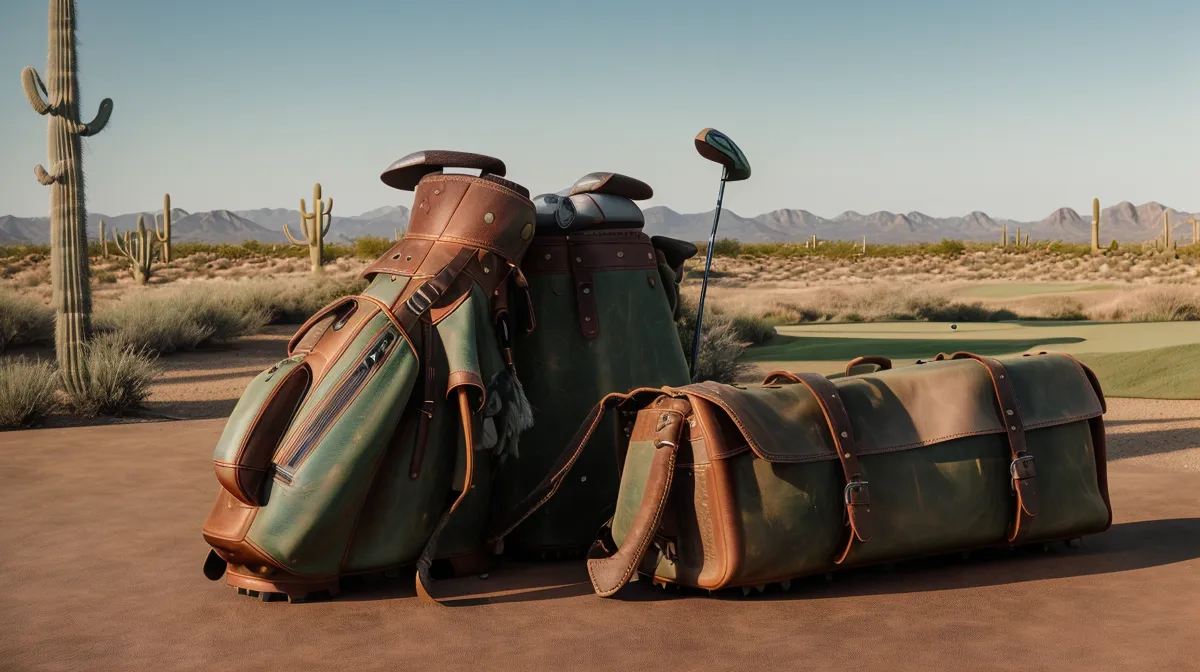
The Titleist AVX launches lower off a driver face than a Pro V1x does, full stop, and that single trait gets it dismissed as a beginner's ball by half the guys in my group at Raven Golf Club at South Mountain. Two dozen of them ride in the truck bed most weeks now, sunscreen and hot rubber baked into the covers before I even reach the first tee, and not one has folded up in a Scottsdale crosswind the way a tour ball does. Desert golf runs on different physics than the ball reviews filmed at sea level ever admit, and after enough rounds tracking flight instead of a spec sheet, the AVX is the clearest example I've got of an amateur mistaking marketing for performance.
Some of the links below send a commission my way if you buy something, and I only recommend gear I've actually rotated through my own bag over dozens of rounds - not stuff a rep mailed me hoping for a nice write-up. You can find the full disclosure in the Editorial Policy.
Why Does Everyone Assume The AVX Is A Senior Ball?
Ask around the grill room at a public course and you'll hear the same line: the AVX feels soft, so it must be built for seniors or high-handicappers who can't compress anything firmer. That's ego talking, not physics. Lonnie Gruber sent me that exact line last spring before he'd hit a single one; that's Lonnie, he'll ask a detailed question about a piece of gear and then keep playing whatever's already in his bag until it actually breaks on him. The myth survives because a softer feel gets coded as "less serious," the same way a smaller daily-driver gets coded as less capable, right up until the smaller truck is the one that actually fits in the garage.
Low Spin Off The Tee Isn't A Compromise Out Here
None of this is Titleist marketing talking; it's what shows up in my own notebook after enough rounds at altitude and under triple-digit heat. Low humidity and thin desert air don't hold a ball up the way sea-level air does, so a high-spinning ball that climbs into a heavy lift trajectory just balloons and drifts sideways once real wind gets involved. The AVX flies lower to begin with, so the wind has less ball to grab.
Drives that flew dead straight on the range kept wandering thirty feet offline on an actual fairway once a crosswind showed up; switching the ball fixed more of that than any swing change I ever paid for. That same pattern showed up when I ran a similar test for my Titleist Pro V1 vs. Vice Pro Plus comparison: spec-sheet spin numbers matter less than how a ball behaves in the conditions you actually play.
The Cover, The Feel, And What Survives A Desert Round
Feel matters just as much as flight once a joint or two starts complaining, and shoes taught me that before the ball did. I still reach for a pair of FootJoy on any day I'm walking eighteen instead of riding, for the same reason I wrote up my best FootJoy golf shoes for knee comfort notes: support and cushion change how the whole round feels, not just how the scorecard looks afterward.
The ball works the same angle. Its cover is a cast urethane blend, softer than what wraps a Pro V1x, and it grabs a chip on a green baked hard enough to putt on instead of skidding thin across it. That same softness cuts the sting through a forged iron on a mis-hit, which matters more than it sounds like once you're picking a ball for how your hands feel on hole sixteen, not just how far it went on hole one.
Same round I first trusted the AVX off the tee at Raven, I pushed my cart down the steep pitch off the 15th one-handed and it tracked dead straight the whole way, no tug against my wrist on a hill that has fought every cart I've owned. That kind of detail is exactly why the notebook exists at all.
The same notebook that tracks the ball tracks plenty besides it: push cart stability on a downhill, how much pressure a putter grip needs before an arthritic hand starts complaining, how many rounds a cover survives on scrape and hardpan before the paint chips through, and how heavy a bag feels by the back nine on a walking day. It also logs how fast a glove gives out once the heat turns humid, whether a compression number actually matches a real swing speed instead of a tour speed, whether a spikeless sole holds on hardpan waste areas, whether a mallet forgives a bad stroke better than a blade ever does, and whether a set of irons launches easy for someone who doesn't square the face every time. A few pages further back cover how much bounce a wedge needs on ground this firm, whether a ball's paint job actually shows up against noon glare, how small a cart folds down for a trunk that already has a cooler wedged into it, whether a shoe's lateral support takes real pressure off a bad knee, whether a utility iron replaces a long iron without giving back yards, and whether an electric assist is worth hauling around on a walking day.
That last question isn't hypothetical anymore; clipping an Alphard Golf Club Booster V2Pro onto my regular push cart took the guesswork out of every downhill at Raven, the same kind of grade that used to require constant hand correction on the way down.
Stop Copying The Tour Bag Before You Test Your Own
I made this same mistake with a putter before I made it with a ball. Switched to a blade a few seasons back because that's what looked right in a tour bag, and lived through six straight rounds of three-putting before I put a mallet back in and admitted a blade wasn't forgiving my miss-reads the way I needed it to. The ball works on identical logic: a tour player chasing more spin and more stopping power on soft, humid greens needs a different tool than someone playing firm, dry Scottsdale fairways at altitude closer to a mile than sea level.
My putts-per-round settled into the low 30s once I stopped fighting the blade, and my scores did something similar the round I stopped fighting the ball's flight and let the AVX do what it's actually built for. Before copying a bag setup off a leaderboard, ask what conditions that setup was built to survive; if the honest answer is humid greens somewhere far from here and you're playing anywhere in the Phoenix valley in July, that mismatch is worth fixing before any swing lesson.
I still keep a dozen AVX in the bag for exactly that reason, and if you want to see where the lower-flight ball sits in the current Titleist lineup, it's worth a look before your next order.