Papago hit 97 degrees by 8:40 on a Tuesday morning back in May, and that's the round where my old Sun Mountain Micro Cart finally gave out. The folding hinge had been loose for two years; it seized solid on the cart path by the 14th green. I pushed my bag the last four holes and decided that was the last cart I'd ever buy off a spec sheet without checking it against carts I'd actually used.
That was cart number nine of fourteen I've rotated through since my knee stopped letting me run and I picked golf up seriously in 2020. I play three rounds a week across Papago, Ak-Chin, and Grayhawk when the Phoenix valley schedule allows it, and somewhere around cart number five I started keeping a notebook of every yardage, ball brand, and grip change; the carts got their own page once I noticed how often the folded-size number printed on the box didn't match what actually fit in my truck bed. I'm playing to a 12 handicap these days, which is exactly the audience this table is for: not tour spec, just what fits, what folds, and what breaks.
Every weight and fold measurement below comes straight from each manufacturer's current listing or an authorized retailer's page, checked line by line rather than copied off an old press release. Two of the carts on the original version of this list had quietly moved on since I first built it. Big Max replaced the Blade IP with the IP2, which added an XL organizer panel and comes in at 14.77 pounds; Motocaddy pulled the Cube from its US lineup entirely and sells the smaller QB2 in its place now. I updated both rows rather than leave a listing pointing at a cart nobody can order new anymore.
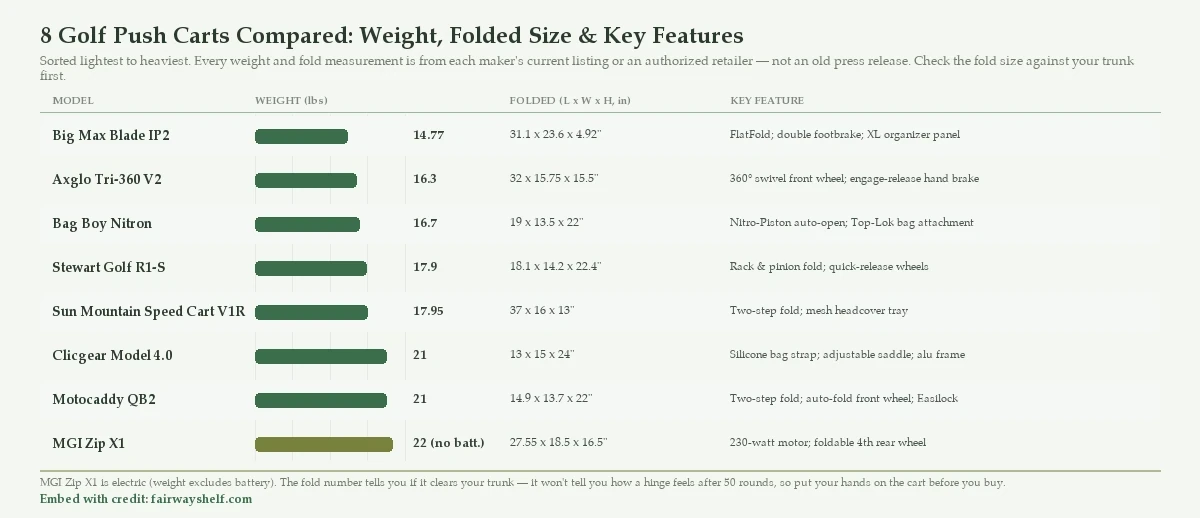
The spec that finally earned its own notebook page: folded size. The number printed on the box didn't match what actually fit in my truck bed — which is roughly how a cart I bought off a spec sheet ended up seizing on the cart path at the 14th and riding home in pieces. Now I check the fold dimensions against my trunk before anything else, and I put my hands on the hinge before I pay. A spec sheet has never once told me how one feels after fifty rounds.
Golf Push Cart Specification Comparison
| Model | Weight (lbs) | Folded Dimensions (Inches) | Key Mechanical Features |
|---|---|---|---|
| Clicgear Model 4.0 | 21 [1] | 13" x 15" x 24" [1] | Silicone bag strap system; adjustable upper saddle; aircraft-grade aluminum frame. |
| Bag Boy Nitron | 16.7 [2] | 19" x 13.5" x 22" [2] | Nitro-Piston auto-open technology; Top-Lok bag-to-cart attachment system. |
| Sun Mountain Speed Cart V1R | 17.95 [3] | 37" x 16" x 13" [3] | Two-step folding mechanism; mesh headcover tray; adjustable bag brackets. |
| Big Max Blade IP2 | 14.77 [4] | 31.1" x 23.6" x 4.92" [4] | FlatFold technology; double footbrake; height-adjustable handle; XL organizer panel. |
| Motocaddy QB2 | 21 [5] | 14.9" x 13.7" x 22" [5] | Two-step folding system; auto-fold front wheel; friction-free oversize wheels; Easilock bag compatibility. |
| Axglo Tri-360 V2 | 16.3 [6] | 32" x 15.75" x 15.5" [6] | 360-degree swivel front wheel; engage-and-release hand brake; scratch-free gliding fold design. |
| Stewart Golf R1-S Push | 17.9 [7] | 18.1" x 14.2" x 22.4" [7] | Rack and pinion folding mechanism; quick-release wheels; silicone bag strap. |
| MGI Zip X1 (Electric) | 22 (no battery) [8] | 27.55" x 18.5" x 16.5" [8] | 230-watt motor; digital electronics; fixed front wheel; foldable 4th rear wheel. |
Technical Definitions
- Folded Dimensions
- The measurement of the cart's volume when fully collapsed for storage. Manufacturers typically report these as Length x Width x Height, though the orientation may vary by model design.
- Nitro-Piston Technology
- A gas-pressurized cylinder mechanism used to assist in the unfolding process, reducing the manual force required to lock the frame into a usable position.
- Rack and Pinion Folding
- A mechanical system where circular gears (pinions) engage linear gears (racks) to synchronize the movement of multiple frame components during folding.
- Top-Lok Technology
- A proprietary attachment system designed to lock specific golf bag brands into the upper bag bracket without the need for traditional bungee or silicone straps.
None of these numbers replace pushing the thing around eighteen holes yourself. The fold measurement tells you if it clears your trunk; it doesn't tell you that the Axglo's hand brake needs a firmer stomp than the Big Max's footbrake, or that the MGI's motor hums loud enough that my playing partners hear me coming from the next fairway before they see me. Check the fold size against your trunk first, then go put your hands on the cart before you buy it — a spec sheet has never once told me how a hinge feels after fifty rounds.
Last verified: 2026-07-17
Sources
- [1] TGW: Clicgear Model 4.0 Specifications
- [2] Bag Boy: Nitron Auto-Open Push Cart Official Page
- [3] Maple Hill Golf: Sun Mountain Speed Cart V1R Product Page
- [4] Big Max Golf: Blade IP2 Specifications
- [5] Motocaddy US: QB2 Push Cart Specifications
- [6] Strictly Golf: Axglo Tri-360 V2 Push Cart
- [7] Motogolf: Stewart Golf R1-S Push Cart Specifications
- [8] ReadyGolf: MGI Zip X1 Electric Cart Specifications